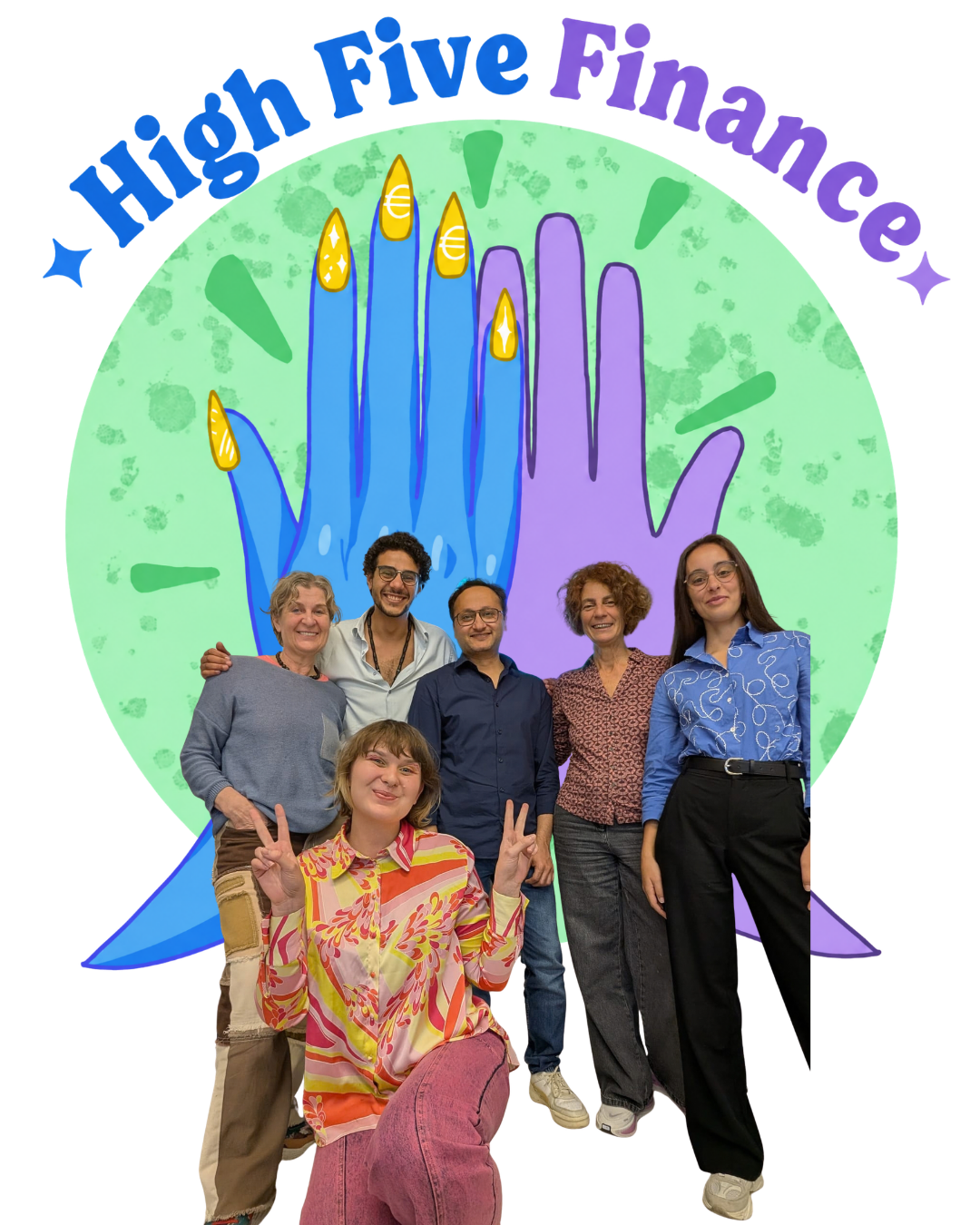
High Five Finance
5 Dimensions to Build a Financial Future for Good
On 1 October, GaiaLux opens a new chapter in its Erasmus+ journey with the launch of High Five Finance (H5F).
H5F is a 12-month Erasmus+ small-scale partnership in the youth field which aims to empower young people to make more responsible and informed financial decisions. Going beyond traditional financial literacy topics such as budgeting and saving, High Five Finance introduces an integrated approach to money, exploring how financial choices can create economic value while considering their environmental impact, social consequences, ethical and governance standards, and long-term resilience.
The project is based on the understanding that financial decisions should not be evaluated solely in terms of costs, returns or immediate benefits. They should also be examined in relation to their environmental footprint, social implications, ethical standards, transparency and capacity to remain viable over time, since financial choices are never neutral, they shape our society, our environment and our collective well-being.
High Five Finance (H5F) aims to develop a decision-making model that brings together these five dymensions, which are all essential to create an integrated approach to responsible use of money:
- Economic viability
- Environmental impact
- Social consequences
- Ethics and governance
- Long-term resilience
The primary target group consists of youth workers, trainers, facilitators, coordinators and educators working with young people aged approximately 15–30. Although these professionals may be familiar with basic financial education, many have limited formal training in finance, economics or investment analysis. They may therefore need additional tools to address topics such as income generation, cost structures, cash flow, risk assessment, financial sustainability, governance and the credibility of environmental claims.
High Five Finance will equip these professionals with a structured, accessible and transferable methodology that can be integrated into non-formal education activities.
Young people are the ultimate beneficiaries, particularly those with limited access to formal financial education, including economically vulnerable and rural youth. In an increasingly complex financial and digital environment, they encounter crowdfunding campaigns, sustainability-labelled products, digital financial platforms and investment-related content, often without a clear framework for assessing their reliability and implications.
The project will help young people move from basic financial awareness towards informed and independent decision-making, enabling them to evaluate whether a proposal is economically sound, environmentally credible, socially responsible, ethically governed and resilient in the long term.
Project Objectives
Objective 1 – Strengthen youth workers’ capacity to teach responsible financial decision-making
The project will enhance youth workers’ financial knowledge and practical teaching skills, extending beyond personal budgeting and saving. Participants will learn to explain how initiatives generate income, how costs and cash flow are structured, how risks can be identified and how long-term financial viability can be assessed.
They will also develop the capacity to connect financial analysis with environmental, social, ethical and governance considerations, enabling them to facilitate a more comprehensive and responsible approach to financial reasoning in non-formal education.
Objective 2 – Enable young people to apply the five-dimension model independently
The project will empower young people to use the five-dimension framework to assess real-life projects, initiatives and financial proposals before making decisions.
They will learn to identify strengths and risks, distinguish credible sustainability claims from misleading information, examine transparency and accountability, and consider long-term resilience. They will also practise justifying their conclusions with evidence and arguments drawn from the different dimensions, rather than relying solely on personal impressions or isolated financial indicators.
The objective is to establish a repeatable decision-making process that young people can use independently in different financial and everyday contexts.
Objective 3 – Embed the methodology in regular youth work practice
High Five Finance aims to develop and validate a practical learning methodology that partner organisations can continue using beyond the project’s lifetime.
The five-dimension framework will be translated into professional guidance for youth workers, youth-friendly learning resources and practical facilitation tools. Through testing and refinement across partner countries, the project will establish a transferable approach that can be integrated into existing youth activities and adapted to different educational settings.
This institutional dimension will support the long-term sustainability of the results and contribute to the quality, innovation and relevance of financial education in youth work.
Main Results and Learning Resources
Result 1 – A validated professional five-dimension financial evaluation model
The project will develop a structured professional framework that establishes a common analytical approach for evaluating financial decisions through all five dimensions.
It will include:
- A financial foundations module covering essential concepts such as income, costs, cash flow, risk and financial viability.
- A formal criteria sheet defining the assessment criteria for each of the five dimensions.
- An integrated decision-making sequence guiding users through the evaluation process.
- A standardised evaluation canvas for documenting evidence, strengths, risks and trade-offs.
- A professional reference guide supporting youth workers in understanding and applying the methodology.
Together, these resources will provide a consistent basis for professional learning, facilitation and application across the partner organisations.
Result 2 – A Youth 5D Toolkit for non-formal education
The professional model will be translated into an accessible and interactive toolkit designed specifically for work with young people.
The toolkit will include:
- A simplified financial basics booklet.
- Structured case files presenting realistic projects, initiatives or financial proposals.
- Question cards addressing the five dimensions.
- A decision board enabling participants to record evidence, strengths, risks and competing considerations.
- A facilitation guide with instructions and activities to support youth workers in delivering the methodology.
These resources will transform a potentially complex analytical process into a practical learning experience, encouraging active participation, critical thinking, discussion and evidence-based decision-making.
Expected Learning Outcomes and Impact
At participant level, young people will develop the ability to apply the five-dimension model to financial decisions in a structured and informed way. They will be expected to assess basic economic viability, recognise environmental and social consequences, examine ethical standards and accountability, consider long-term resilience, and justify their conclusions using evidence from multiple dimensions.
Youth workers will strengthen their capacity to facilitate the methodology autonomously. This includes guiding structured discussions, helping participants identify and compare risks, managing trade-offs between competing priorities and ensuring that decisions are assessed across all five dimensions.
The project will monitor progress against the following targets:
- At least 80% of participating youth workers will be able to apply the professional model independently and correctly.
- At least 70% of participating youth groups will meet the defined criteria for multi-dimensional financial reasoning.
At organisational level, the project will establish a field-tested learning system that partner organisations can reuse and adapt in future youth work activities. The methodology and resources will be refined using feedback and implementation evidence gathered across countries.
Sustainability and Transferability
To ensure that the project produces lasting benefits, the final resources will be made available in both digital and printable formats. The partnership will consolidate the results of testing, incorporate lessons learned and prepare a sustainability plan for continued use of the methodology.
Project Acronym: High Five Finance,
Project Number: 2026-1-LU01-KA210-YOU-000453398
Partners: Alfa Edu srl, MPRO


Other Events
Allez L'Éco, Article, Events, News
Article, Events, News, Senza categoria
