
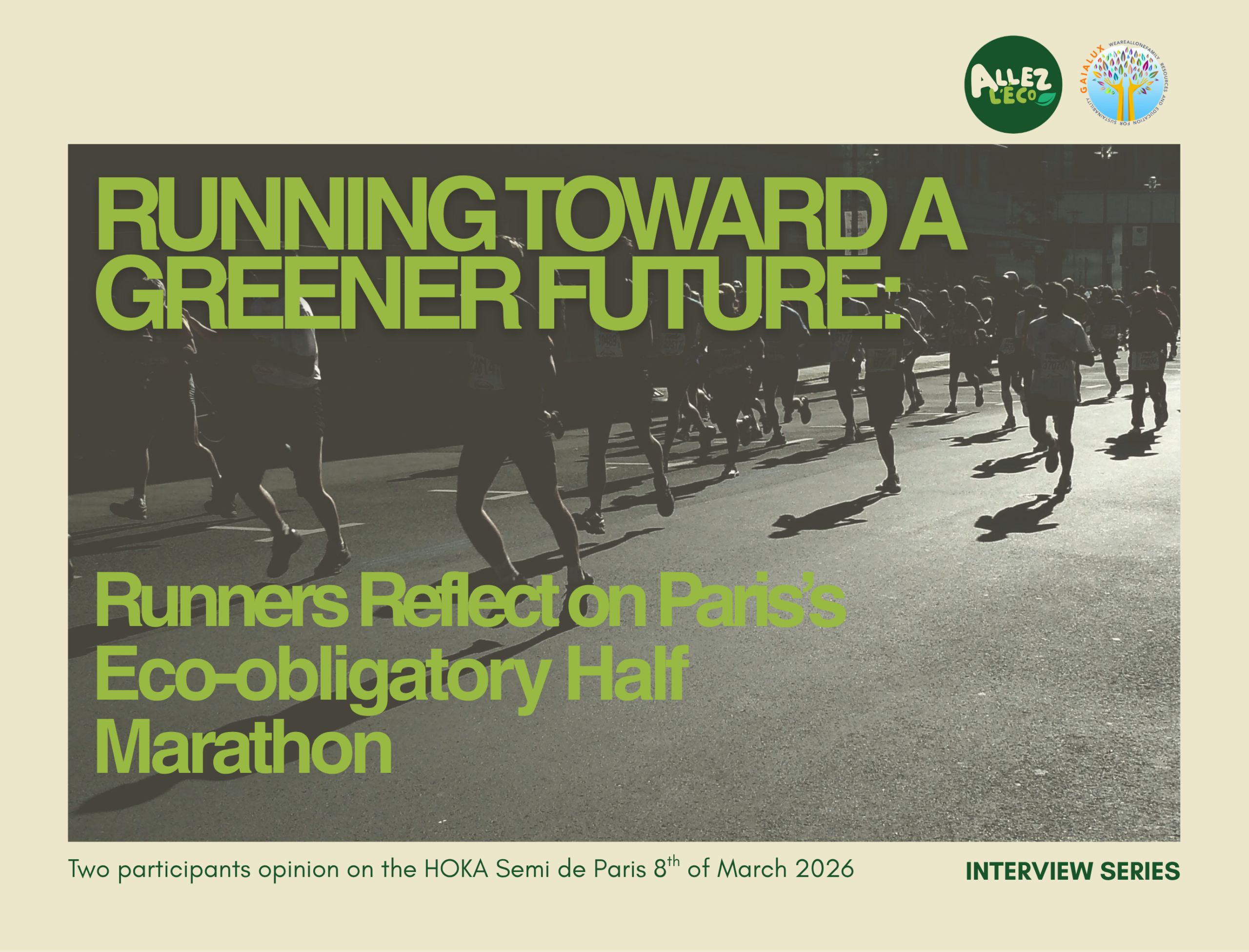
The HOKA Semi de Paris 2026 implemented changes that reflected a broader policy shift at the city level, where Paris has moved to ban single use plastic cups and push for more sustainable practices across all major running events, turning the half marathon into one of the first concrete testbeds of this new “ecoobligatory” framework for races in the capital.
Sport events are a key source of massive waste, and running races, such as mass participation marathons, are among the most visible examples, with tens of thousands of participants using single use cups, bottles, bibs, and T-shirts over a few hours. We interviewed two participants of the HOKA Semi de Paris 2026 to understand what they thought of these changes and the impact it can have in the sport.
Interviewer: How would you describe your overall race experience in light of the sustainable choices made by the event? Did they support, distract from, or barely affect how you experienced the race as a runner?
Ampeglio: The sustainable choices certainly supported my experience rather than distracting from it. I was pleased to see organisers increasingly taking environmental criteria seriously as a standard part of event planning. It makes racing feel more in tune with current values and adds to the positive atmosphere.
Emanuele: My overall experience was also positive. The sustainability measures were well‑communicated before the event, and the race crew provided great support, especially when it came to water access. I noticed far fewer waste materials left along the road compared to other races, which really contributed to a cleaner and more enjoyable run.
Interviewer: Based on your experience, do you think the sustainable choices actually had a noticeable impact, and would you recommend this approach to other half‑marathons or similar races?
Ampeglio: Yes, I found the Paris Half‑Marathon model to be exemplary. Even though my road‑running experience is limited, I believe this event could set a benchmark for others aiming to combine athletic excellence with sustainability.
Emanuele: I also noticed a clear impact. The water stations were well‑spaced, supply areas weren’t overcrowded, and many runners carried their own bottles, all of which made the race smoother. I’d strongly recommend continuing these efforts and expanding them by encouraging sustainable transport to the race.
Interviewer: If you had to design one sustainability feature for the next edition from a runner’s perspective, what would it be, and what would you remove from this year to balance it?
Ampeglio: I’d introduce an initiative encouraging runners to choose more durable shoes — models designed for around 1,000 km of use , which would help reduce overall consumption and waste. Most half‑marathon runners don’t need highly specialised racing shoes meant for professionals.
Emanuele: I’d follow the example set by the UTMB ultra‑trail race and offer discounts to runners who travel to Paris via public transportation. This would encourage greener travel choices. To balance this, I’d remove less essential materials provided at the start or finish that often end up as waste.
Interviewer: Given that this was a half‑marathon, do you think the new sustainable choices would work equally well at the scale of a full marathon, or would you advise a different strategy?
Ampeglio: I think the same sustainable approach would work perfectly for a full marathon. The core measures are scalable, and participants increasingly expect events to reflect these values.
Emanuele: I agree. The model used at the half marathon can easily be replicated for longer distances like a full marathon. It’s aligned with what modern runners want, a race experience that’s both enjoyable and environmentally responsible.
Interviewer: What additional methods should the organizer consider to address the concerns of the runner who are worried about the impact of these measures on the sport performance?
Emanuele: While a large share of participants to these events will be motivated to the overall purpose of the sustainability initiative and will accept more easily the proposed changes, even if they are coming at the cost of performance, the will be others who are putting performance above as a priority. To this group, organizer will need to have more dedicated initiatives including: tailor ex ante communication about the modalities of the event, application of harmonized roles across different events to ensure a level planing field across competition, but also identification of alternatives to the use of non sustainable practices, like plastic bottles, that can have a lower impact on performance: for example replacing plastic cups with compostable items, distribute reusable cups upon deposit that can be easily taken back (as we experienced in the Ekiden Marathon in Brussels recently). However, those are all second best options since they are also implying a use of material and resources, so perhaps the real challenge is to face the change and make the sustainable the ‘new normal’.
Interviewer: Do you have any final consideration for the future?
Emanuele: I am increasingly coming to the conclusion that in the future we will need to modify the current trend towards large scale running events whose impact on the environment is very large, including to the carbon foot print of traveling. This is clearly driven by commercial considerations. It could be interesting for the running community to promote a more sustainable way of running going for small scale local sustainable events. One of the most famous trail running athlet in the world killian Jornet has made this point laud and clear.