

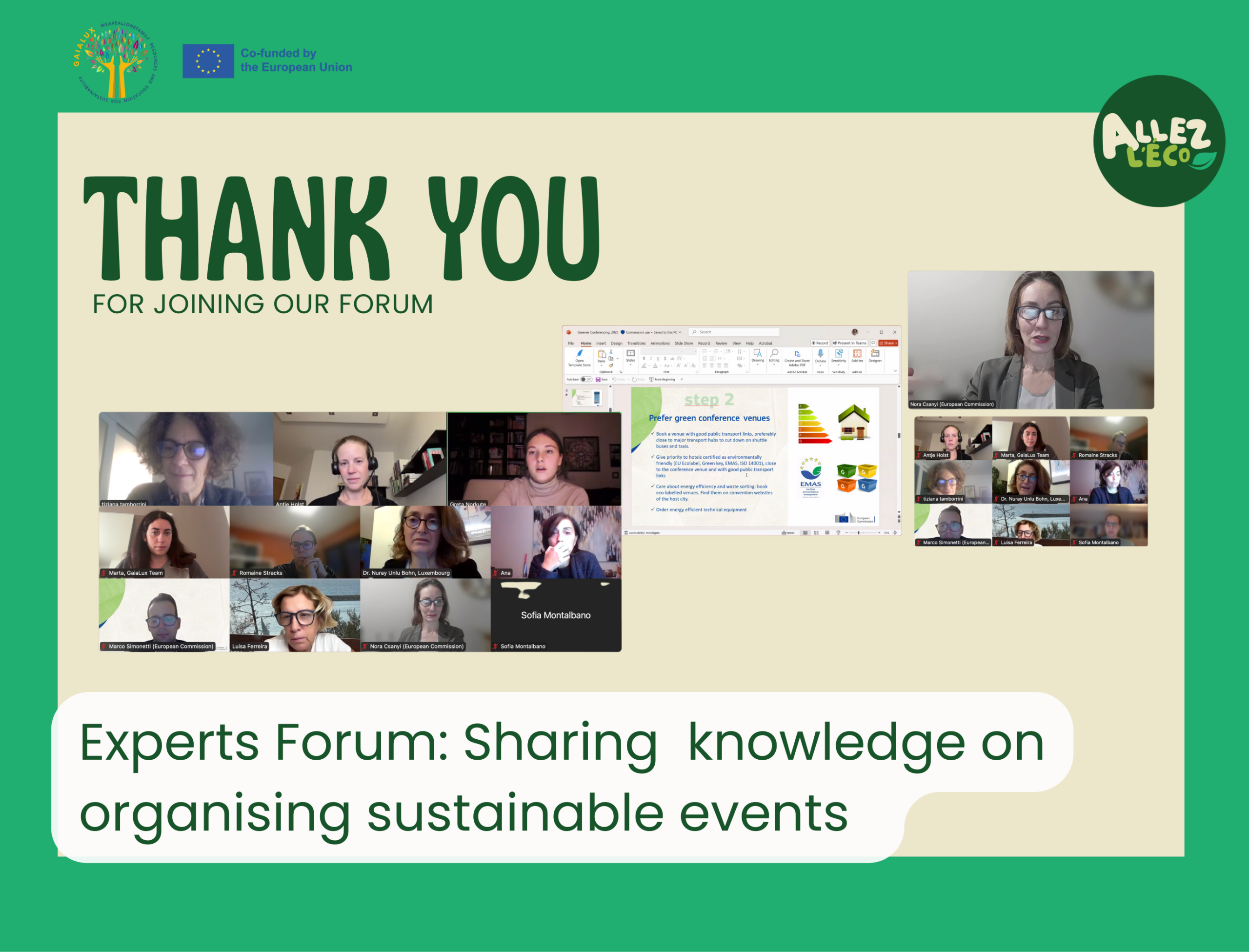
On 29 October and 19 November 2025, we held the first forums of the Allez l’Éco project on sustainable events, organized by GaiaLux. The events brought together an exceptional community of experts, independent professionals, — from the European Commission to local organisations, systemic thinkers, and social innovators — and youths from local schools all united by a shared vision: building a culture of sustainability and inclusion in the events world.
This article offers an overview of the key outcomes of the two virtual forums which represents the set the stage and official launching of project Allez l’Éco allowing to get deeper into the the development of the Educational Pack of the project targeting a diverse group of beneficiaries comprising young people aged 16+, youth workers, and educators.
The forums played a strategic role in the project by:
- gathering expert knowledge and practical experience on sustainable event management;
- identifying the needs, motivations, and perceptions of young people regarding sustainability;
- translating these insights into concrete learning modules for future training activities.
First Forum: Expert Insights on Sustainable Event Organisation
The first forum brought together sustainability experts from European institutions and national initiatives including: Ana Gamero – Independent consultant and PCC-certified coach; Luisa Ferreira – Independent consultant and former Economic Advisor at the European Investment Bank (EIB); Nora Csànyi – Representative of the Conference Organisation Unit (DG SCIC), European Commission; Marco Simonetti – Representative of the Conference Organisation Unit (DG SCIC), European Commission; Romaine Stracks – Representative of SuperDrecksKëscht® (SDK); Tiziana Tamborrini – Sustainability expert and EU Climate Pact Ambassadors Project Coordinator of Allez l’Éco; Nuray Ünlü Bohn – Independent consultant and EU Climate Pact Ambassador.
In parallel with the two forums, the Gaialux team conducted interviews with additional experts, including Marie-Béatrice Noble, EU Climate Pact Ambassador and organiser of the Festival AlimenTERRE; Chris Knights, EIB officer and member of the sustainable working group at the European School of Mamer, focusing on student-led climate action initiatives in the food waste sector; and Nora Csány, representative of the Conference Organisation Unit (DG SCIC) of the European Commission, who also participated to the Forum.
Key Topics and Good Practices
Experts from the EU Commission Conference Unit highlighted the significant environmental footprint of professional events and conferences, stressing the urgent need to align event practices with the European Green Deal and climate objectives. Particular attention was given to virtual and hybrid event formats, which can reduce travel-related emissions by up to 90–94%.
A structured seven-step approach to sustainable event planning was presented, covering:
- event concept and design,
- venue selection,
- mobility and transport,
- catering,
- waste management,
- communication,
- procurement
Practical planning tools, such as backward planning (retro-planning) using simple task-tracking spreadsheets, were recommended to ensure efficiency and continuous improvement, including post-event evaluation.
Circular Economy, Catering, and Waste Management
Strong emphasis was placed on applying circular economy principles, particularly the 5R framework (Refuse, Reduce, Reuse, Recycle, Rethink). Experts stressed that “Refuse” and “Rethink” are most effective when applied at the design stage, to prevent waste before it is generated.
SuperDrecksKëscht® , the Luxembourgish national programme for ecological waste management and responsible for the green event label in Luxembourg (together with Oeko-Pfaffental), shared its experience with practical checklists based on yes/no questions, supporting event organisers in implementing concrete measures such as:
- eliminating single-use plastics,
- using reusable cups and food containers,
- collaborating closely with caterers and suppliers.
Technological solutions were presented as valuable tools for monitoring food waste, optimising resource use, and enabling the donation of surplus food. Innovative circular solutions, such as transforming used cooking oil into biogas or eco-detergents, were also discussed.
Accessibility, Inclusion, and Social Impact
Beyond environmental aspects, experts underlined the social dimension of sustainability. Accessibility for people with disabilities was identified as a key criterion in venue selection, alongside the importance of inclusive participation through hybrid formats.
Ethical procurement was also highlighted, encouraging the selection of event gifts and services from social enterprises or organisations employing people from vulnerable or marginalised groups, thereby combining environmental responsibility with social impact.
Finally, robust monitoring and evaluation of both process and results are essential to identify key challenges and provide guidance for improved implementation. They also represent a crucial learning opportunity to refine ongoing efforts and to strengthen motivation, cohesion, and ownership within the local community, which are fundamental for fostering resilient, collaborative, and long-term change.
Training Modules Derived from Expert Contributions
Based on the first forum, several core modules were defined for the Educational Pack, including:
- sustainable planning and governance,
- waste reduction and circular economy,
- sustainable transport and mobility,
- local sourcing and sustainable supply chains,
- accessibility and cultural inclusion,
- communication, reporting, and impact measurement.
These modules aim to provide practical, results-oriented tools that can be adapted to events of different sizes and contexts.
Second Forum: Youth and Youth Worker Perspectives
The second forum focused on young people and youth workers, exploring how sustainability is perceived in real-life event contexts such as schools, NGOs, youth parliaments, cultural initiatives, and community projects.
Participants from local schools and grassroots initiatives described sustainable events as consciously-planned, environmentally responsible, and socially fair, with an emphasis on minimising long-term harm to communities and ecosystems. Most agreed that events should always strive to be sustainable, even if full sustainability is not always achievable due to budgetary or logistical constraints.
Challenges and Priorities
Key challenges identified by participants included:
- perceived high costs of sustainable solutions,
- transport and energy-related emissions,
- limited awareness or motivation among attendees,
- difficulties in communicating sustainability measures effectively.
When asked to prioritise actions, young participants favoured low-cost, practical solutions, such as:
- reusing or borrowing materials,
- using reusable cups and plates,
- promoting sustainable transport,
- replacing printed materials with digital tools.
Within the 5R framework, “Rethink” and “Reduce” were most frequently selected, reflecting the importance of integrating sustainability from the earliest planning stages.
Conclusions and Lessons Learned
The two forums demonstrated strong alignment between expert knowledge and youth expectations. Key lessons learned include:
- the importance of structured and proactive planning for successful sustainable events;
- the need to reduce environmental footprints through informed choices on format, mobility, and venues;
- prioritising waste prevention and resource efficiency over end-of-pipe solutions;
- integrating social inclusion and accessibility as core sustainability dimensions;
- ensuring transparent communication and impact measurement to avoid greenwashing and foster long-term behavioural change.
These insights provide a solid foundation for the development of the Allez l’Éco Educational Pack, ensuring that future training activities are practical, inclusive, and genuinely responsive to the needs of young people and youth organisations.
Other Events
Allez L'Éco, Article, Events, News
Article, Events, News, Senza categoria
