
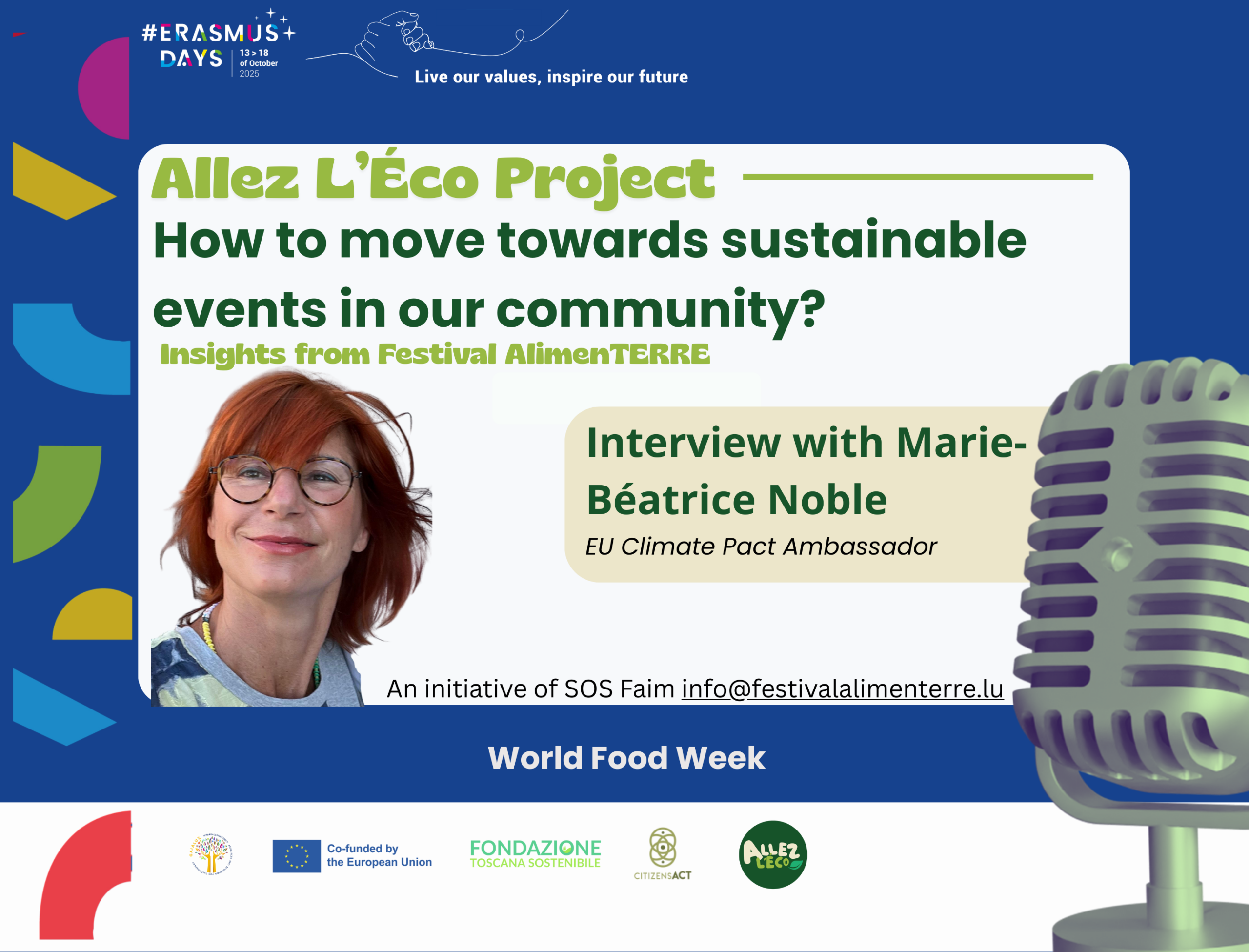
Interview 14.10.2025
Interviewer: Can you share any insights from the conception of the festival? Did you and your team decide early on to take action to reduce the climate impact?
Marie: So, this wasn’t a topic addressed collectively at first because the festival involves a big group—25 NGOs discussing from a very early stage how to create the event. Most people around the table already have a high awareness of CO2 and social justice. Many belong to associations like Slow Food or groups working on southern issues. So, you don’t really have to tell them what to do or not do. Naturally, they look for alternative, local screening venues. It’s really in their DNA.
Interviewer: That’s great to hear.
Marie: For my part, it’s a bit different. I do a couple of things: I contact large companies because they usually have auditoriums. They can screen festival films for their employees within workplace buildings and organize catering aligned with the movie’s theme. The advertising stays internal on their intranet, so there’s no paper production — very low carbon emissions. The room belongs to them, so the footprint is low.
What we emphasize most is the catering. We provide them with a list of local caterers who support the festival’s spirit, but they are free to choose whoever they like. Some companies invite their canteen chefs to challenge them to come up with special dishes for the event.
My main priority is food waste and food loss — this is not about changing the diet proposed by Companies, but about minimizing waste. People have to register attendance properly, with the message: “If you cannot come, please let us know the day before because we want no waste.” This is the first and most important rule.
Secondly, companies have to manage leftover food responsibly; it should never be thrown away. The next priority is what I call “vegetalisation”: recipes based on vegetables, nuts, fruits — some even go vegan, others less so, but all follow this guideline.
Organic food is a wish. It’s difficult to organize, find the right products, and keep it local, so this remains a goal rather than a full practice yet.
Finally, a crucial aspect is avoiding single-use utensils. Companies use real dishes for the events to avoid plastic waste.
Interviewer: It sounds like the food and waste management have become central sustainability pillars. What about the event experience itself? How do you balance showing films with encouraging action?
Marie: That’s a great question. The AlimenTERRE Festival is not just a movie festival; it’s much more than that. It’s a platform for action and exchange. Actions are an experience. The festival is designed to not only screen films about food and sustainability but to create a space where people actively engage, discuss, and share ideas.
It’s about activating synergies between what people watch and what they can actually do in their daily lives and communities. This practical aspect is what makes the festival unique—it goes beyond passive viewing to inspire real change.
Interviewer: That’s inspiring. And how do partner organizations influence these sustainable practices?
Marie: The partners almost all operate with a high conscience about climate impact and social justice. When they gather for planning, it’s very natural for them to seek out local venues and organize in a way that supports their values. This sense of responsibility and ethics is embedded in their culture. You don’t have to push it on them; it’s part of what drives their work.
Interviewer: And what about involving companies and influential groups? What’s the strategy there?
Marie: We choose partners and companies that are influential in their community because they can lead by example. When you mix people who already know and care with those who are part of the local community but less familiar with sustainability, trust builds naturally. People learn by example. It’s about creating an environment where knowledge spreads organically through trusted networks.
Interviewer: It’s interesting to hear how these companies are already engaged and even labeled as green events. Have many of them taken up the challenge to innovate with their catering, for example, by working with chefs?
Marie: Yes, quite a few. Some have accepted challenges to develop unusual dishes aligned with themes of the films. For example, one chef created a seaweed tartar inspired by a film about the ocean and how our food choices affect its state. The chef’s family loved it—it was both tasty and highly nutritious.
We split the festival into two sections: working directly with companies is one part, which is easier to organize, and then there is the big public event, which is more challenging.
I also looked at the criteria for a green event label from the ministry. Honestly, at the beginning of the summer, I thought I would get the label, but then I realized how much work is involved and we decided not to pursue it this year. However, we are essentially doing everything as if we had the label.
For example, the venue is accessible by tram, so mobility is already addressed.
Interviewer: That is impressive. And what about the more casual aspects, like popcorn during the screenings? Have you addressed that in terms of sustainability?
Marie: Popcorn is always a hot topic. Last year, we debated whether to close the popcorn shop or let people decide. It’s not really a sustainable product, but for many, movie experiences include popcorn. It’s a moment of pleasure, and we didn’t want to impose too much. So, if the shop is open, it’s open; if it’s closed, it’s closed. We let nature decide.
Interviewer: That’s a very balanced approach. I guess different generations have different views on this?
Marie: Absolutely. Older generations might be purist about no food in movie theaters, but younger people love having popcorn or snacks with their movies. Our habits evolve.
At the event reception, we ensure there is no paper waste, and this year we plan to improve the system further.
Interviewer: It seems there are detailed plans also for registration and managing attendees?
Marie:
My main priority is food waste and food loss — this is not about changing the diet proposed by Companies, but about minimizing waste. People have to register attendance properly, with the message: “If you cannot come, please let us know the day before because we want no waste.” Companies have also to manage leftover food responsibly; it should never be thrown away.
The next priority is what I call “vegetalisation”: recipes based on vegetables, nuts, fruits — some even go vegan, others less so, but all follow this guideline.
Interviewer: And waste management during catering and the event?
Marie: Food waste is carefully managed. Leftovers are separated from other waste and composting is done. NGOs take care of the leftovers and handle them though their channels, so the aim is that nothing is wasted on site.
Interviewer: That’s great to hear. I often hear that in some places, a large amount of food waste is still incinerated? Is this different with the companies you work with?
Marie: Yes. Many large companies have sustainability reports. They prioritize donation first, composting second, then biomethanation. They use technology to monitor leftovers and adjust ordering accordingly, which is a real lifesaver.
Interviewer: It’s impressive to see how active and diverse the festival is, engaging with so many countries and communities. What do you think is the core message that the festival aims to convey?
Marie: The core message is that food systems are at the heart of many environmental and social challenges. The festival aims to provoke reflection and encourage collective action by showcasing stories from around the world that highlight both problems and solutions. It’s about questioning the way we produce and consume food and inspiring people to make conscious choices that support sustainability and justice.
Interviewer: That’s very impressive. What’s next for the festival, and what are your hopes?
Marie: The goal is continuous growth—as an event and as a movement—building bridges between people, cultures, and sectors focused on sustainable food systems. We want to deepen citizen awareness and engagement, especially among youth, and foster partnerships that lead to concrete changes in agriculture, consumption, and policy.
Through stories and discussions, the festival invites everyone to rethink how food connects us and impacts the planet, ultimately working for a fairer, more sustainable future.
Other Events
Allez L'Éco, Events, News
Article, Events, News, Senza categoria
