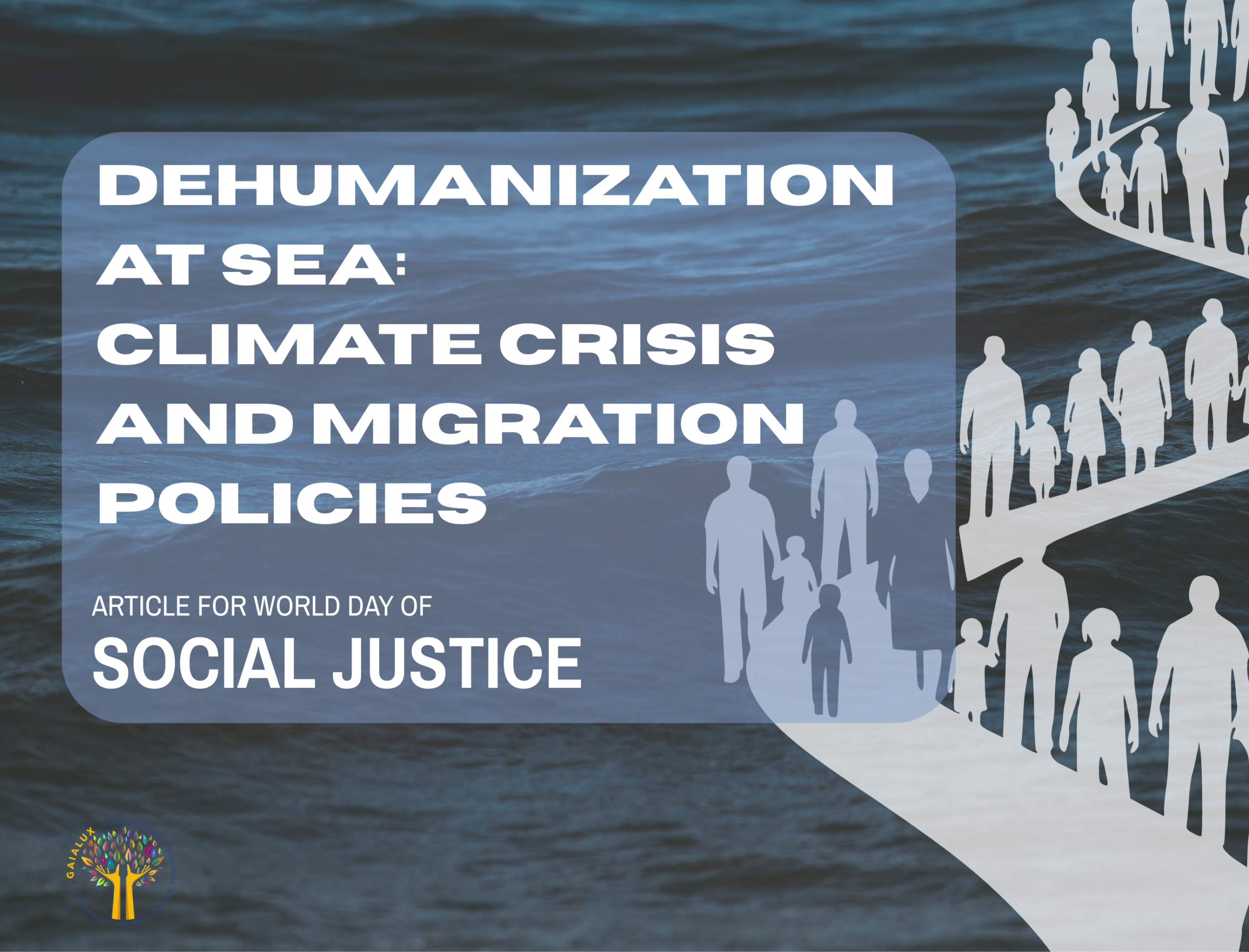
Today, on World Social Justice Day, our thoughts go to the recent events in the Mediterranean.
They painfully remind us how deeply interconnected social justice and climate justice truly are.
At the gates of what has increasingly been referred to as ‘Fortress Europe’, human lives and rights struggle to be upheld, taking on different weight and visibility — a process that weakens our democracies and fuels a deep sense of despair in the face of the recent further restrictions on the right to asylum (DW, Amnesty International, UNHCR global trends ). Forced migration and the climate crisis reveal the consequences of a model of development that has severely impacted parts of humanity, creating deep and unequal exposure to poverty, human rights violations, and economic and climate insecurity. The right to seek protection when fleeing extreme living conditions cannot simply be removed through laws and regulations. It is as old as humanity itself — and a sensitive barometer of how humane our societies truly are. It has not always been this way. There was a time when our sea offered hope, and providing shelter to those in peril was as unquestioned as the right to rescue at sea. Over the last twenty years, however, approaches to forced migration have shifted dramatically: the end of Operation Mare Nostrum (Amnesty Internetional), the criminalization of civil rescue missions (The Guardian), and the EU’s border-focused operations (AbolishFrontex, Eu Migration and Home Affairs) illustrate the transition from proactive rescue to securitized management of the Mediterranean (despite scientific evidences have shown that ‘Search-and-Rescue in the Central Mediterranean Route does not induce migration: Nature.)
What happened between 14 and 21 January 2026 in the Mediterranean Sea — one of the deadliest routes of forced migration — is just one of many stories from recent years, but it is especially shocking: both because of the extreme climate conditions involved and because so many lives disappeared in near silence from the media.
In those days of January Cyclone Harry — unusual both in timing (such storms are rare in this season) and in intensity — severely hit Sicily and its communities. While these extreme weather events made headlines, far less attention was given to another tragedy unfolding at sea. In those same storm-tossed waters, off the eastern coast of Tunisia, several boats departed carrying 49, 54, 50, 51, 36, 42, 53, and 45 women, men, and children — around 380 people in total. By 24 January, none of these boats had been located and no rescue had been reported (The Guardian, Infomigrants, IOM, ). These departures coincided exactly with a period of extreme marine conditions in the central Mediterranean, including the route from Sfax to Lampedusa: waves over seven metres high and wind gusts exceeding 54 knots, driven by Cyclone Harry. In other words, these boats did not simply “disappear” — they were lost during some of the most dangerous sea conditions recorded in the Mediterranean in the past twenty years. These people vanished into the Mediterranean, unseen and unheard.
The full scale of the loss may never be known.
Extreme climate events hit hardest those who are already vulnerable. People fleeing conflict, poverty, and instability found themselves trapped between closed borders and a violent sea (see how the power of these extreme weather have changed in the last years: the Climate Meter, Climate Change and displacement).
This injustice is further compounded by the recent European Union regulations that have significantly restricted access to asylum, limiting protection pathways for those seeking safety. At a time when climate-related displacement is rising, narrowing the right to asylum deepens inequality and shifts responsibility away from those most able to respond.
Around the world, similar stories unfold — from communities displaced by floods to workers losing livelihoods due to drought. The climate crisis does not impact everyone equally; it amplifies existing inequalities, hitting hardest where social protection systems are weakest.
World Social Justice Day is a moment for us to reaffirm the importance of building a just and equitable society for all. It is a reminder that climate action must also be social action — grounded in solidarity, fairness, and the recognition of our shared responsibility to protect both people and the planet.
Other Events
Allez L'Éco, Article, News